A collective approach to combat youth substance abuse
KINLEY KHANDU CHODEN | Thimphu
Substance abuse among young people is becoming one of Bhutan’s growing social concerns, affecting families, schools, and communities across the country.
What was once quietly discussed within households is now emerging as a wider social issue, driven by peer pressure, emotional distress, unemployment, family conflict, academic pressure, and limited opportunities for youth.
According to recent records, more than 50 percent of drug-related arrests in recent years involved individuals below the age of 24, with some offenders as young as 13 to 16 years old.
The growing involvement of young people has raised concerns among parents, educators, and policymakers about the long-term social impact of substance abuse.
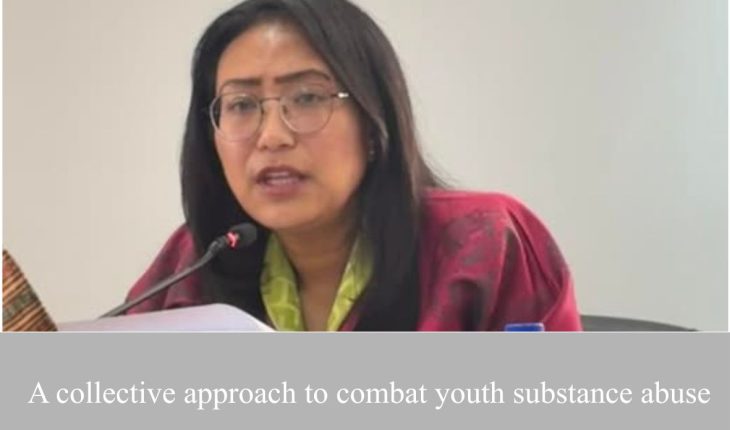
In response to the increasing concern, the Minister for Education and Skills Development (MoESD) Yeezang De Thapa said that the ministry is strengthening prevention and awareness programmes in schools through a compassionate and community-based approach.
“The Ministry recognises that behind every statistic regarding substance use is a human story — a child, a parent, and a community,” the Minister said during the 27th Meet the Press session held on May 8th.
“Therefore, the Ministry is implementing a multi-layered ‘circle of care’ strategy to achieve a drug-free society.”
The Minister explained that the approach moves away from traditional disciplinary measures and instead focuses on compassion, early intervention, and stronger human connection.
One of the major initiatives introduced under the School Health and Wellbeing Strategy is the Mentor-Mentee Programme, which aims to create stronger relationships between teachers and students.
“The most important programme that stands out is the Mentor-Mentee Programme which nurtures a caring culture between staff and students, providing children with a sense of value and guidance to reduce the desire for substance escape,” the minister said.
Officials added that mentors are encouraged to assume a parental role within schools so that every child feels supported and heard.
Beyond schools, the Ministry said families also play an important role in prevention efforts. Recognising the family as a “critical line of defence,” MoESD launched the Helping Adolescents Thrive (HAT) initiative with support from UNICEF.
The programme equips parents with communication skills and practical tools to better support adolescents facing emotional or behavioural challenges.
“Currently, the HAT programme is being offered in 168 schools where children face a higher risk,” the minister added.
The Ministry also collaborates with the Royal Bhutan Police to conduct advocacy and awareness programmes in schools on both the health effects and legal consequences of drug use.
“With this active collaboration, the RBP is repositioned not merely as a law enforcement entity but as a vital community partner in the collective pursuit of a drug-free society,” the minister assured.
Across Bhutan, many families say substance abuse often begins quietly, making it difficult for parents to notice early warning signs. Families report seeing changes in behaviour, withdrawal from studies, emotional distance, and secrecy among affected youths.
“As a parent, I feel many families are struggling but do not know how to respond,” said Karma Lhamo, a mother from Paro. “Sometimes children do not speak about their problems, and parents also fail to ask. The silence makes the problem worse.”
Community members also believe that substance abuse should not only be viewed as a criminal issue, but as a reflection of deeper emotional and social struggles faced by young people today.
“People are quick to judge young people who use substances, but many do not ask why they began in the first place,” said Tshering Dorji, a shopkeeper in Thimphu. “Some youths feel lost, unemployed, or pressured, and they fall into unhealthy company.”
For many Bhutanese, stigma remains one of the biggest barriers preventing families from seeking help. Fear of judgment often forces families into silence, delaying support and intervention.
“In our society, families still hesitate to talk openly about these issues,” said Sonam Wangdi, a resident of Punakha. “People worry about what others will say. But silence does not protect anyone.”
Recovered substance users also say family support plays an important role in rehabilitation and recovery.
“When I first started, I thought it was harmless and just something everyone around me was doing,” said Tandin, a 24-year-old recovered substance user from Thimphu. “But slowly it took over my life. I stopped caring about my family, my future, and myself.”
Tandin added that recovery became possible only after receiving support from his family rather than rejection.
“My family suffered because of me, but they still gave me another chance,” he said. “Recovery is difficult because people remember your past more than your effort to change. But change is possible if someone is willing to help instead of only blaming you.”
Many Bhutanese believe prevention efforts must begin at home, in schools, and within communities through open communication, emotional support, and stronger youth engagement.
“Adults often tell young people what not to do, but they do not always listen to what young people are feeling,” said Dechen, a resident of Thimphu. “Young people need understanding, guidance, and meaningful opportunities.”
As Bhutan continues to address growing concerns over youth substance abuse, the Ministry says its efforts will continue to focus on empowerment, awareness, and human connection rather than fear and punishment.
“Through these integrated initiatives, we are nurturing an ecosystem that promotes a drug-free future,” the Minister stated.
“Our progress is driven not by fear, but by empowerment, intentional engagement, and the strength of human connection.”