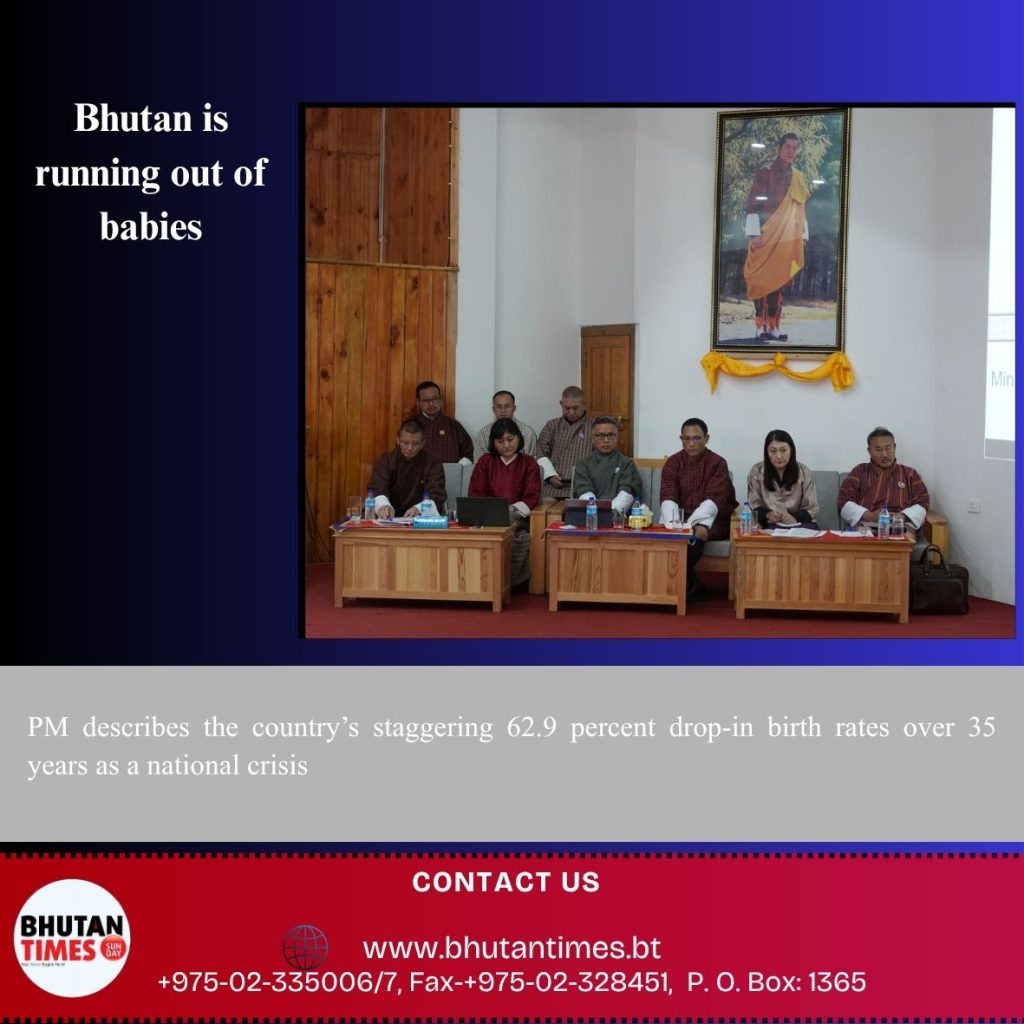
PM describes the country’s staggering 62.9 percent drop-in birth rates over 35 years as a national crisis
NGAWANG JAMPHEL | Thimphu
In the high-tech corridors of Bhutan’s newest medical facilities, the machines are humming with more efficiency than ever before. Dialysis machines are running, IVF services are operational, and digital health records are accessible at the click of a button.
But outside these walls, a silent crisis is brewing that threatens the very foundation of the country.
Bhutan is running out of babies, and the people required to care for them are leaving the country in search of greener pastures.
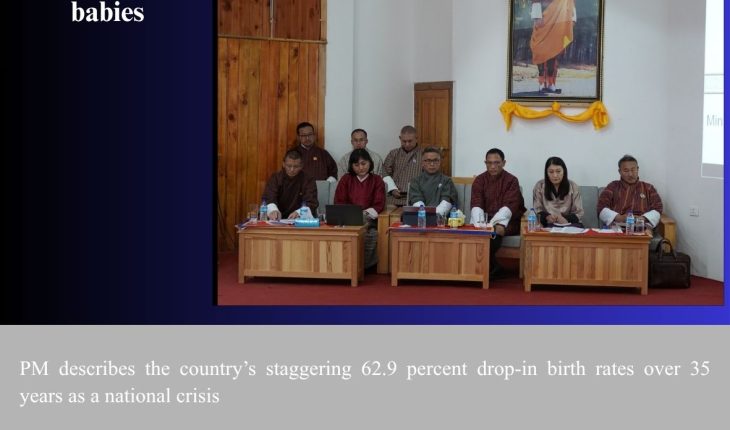
During a high-stakes mid-term reinview for the Ministry of Health (MoH) and National Medical Services (NMS), Prime Minister Tshering Tobgay pulled no punches. He described the country’s current demographic shift, a staggering 62.9 percent drop-in birth rates over 35 years as a “national crisis.”
The numbers are stark: in 1990, the country recorded 15,580 births; by 2025, that number plummeted to just 5,784.
The Mathematics of a Shrinking Nation
The downward trend revealed by the Ministry of Home Affairs is not just a dip; it is a free-fall. From 14,461 births in 2000 to 12,702 in 2010, the decline remained steady.
However, the most recent data shows a sharp acceleration of this trend. In 2020, births dropped to 10,225, and by 2025, they nearly halved again.
The PM warned that without immediate intervention, Bhutan might see as few as 2,000 births by the year 2028.
“It is the responsibility of all of us,” the Prime Minister stated, comparing the level of population decline to countries ravaged by war.
He said the sustainability of the nation’s social protection systems, workforce, and cultural identity hangs in the balance.
“While the “small family, happy family” slogans of the early 2000s may have encouraged smaller households, the current reality is far more complex, driven largely by a “mass resignation” of civil servants and the migration of the nation’s youth,” he said.
The “Australia Factor” remains a central point of concern. The Prime Minister pointed out that while approximately 37,000 Bhutanese currently reside in Australia, only 307 children were born to that group in a single year.
Given that those who migrate are typically in their most productive years for childbearing, their absence creates a double vacuum: a loss of current labor and a loss of future generations.
Modernizing Medicine Amidst Human Resource Gaps
While the demographic clock ticks, the Ministry of Health is racing to modernize.
Under the 13th Five-Year Plan, the Kingdom has seen remarkable technological leaps. The electronic Patient Information System (ePIS) has achieved 100 percent implementation across facilities, serving 92 percent of the national population.
In a major win for healthcare accessibility, high-end services like In Vitro Fertilization (IVF) and dialysis were fully rolled out by mid-2025.
However, a hospital is only as good as the people working in it. As of 2026, only 73.51 percent of health facilities meet basic human resource standards.
The shortage is most acute among doctors, where only 59 percent of the required standard is met. Nurses and health assistants fare slightly better at 73 percent and 89 percent, respectively.
While the attrition rate for critical health workers saw a hopeful drop from 11.24 percent in 2024 to 5.7 percent in 2025, the overall human resource standard remains below the 80 percent target.
The Prime Minister emphasized that leadership must do more to retain talent. He called for civil servants to be empowered through team building and delegation, urging leaders to “let them hear our concerns before they leave.”
The sentiment from the public is equally clear: people feel the absence of professionals in the wards, and there is an urgent need to make health workers feel valued through better incentives.
Budgetary Shifts and Infrastructure Milestones
The National Medical Services (NMS) has been busy managing the financial side of this transition. NMS has utilized 66 percent of its Nu 5.6 billion budget for the 2024–2026 period.
Additionally, in a strategic administrative shuffle, major projects worth Nu 3.2 billion—including the National Cancer Centre and the Royal Centre for Infectious Disease—are being transferred to the Ministry of Health. This shift adjusts the total NMS outlay to Nu 11.6 billion.
Infrastructure progress is one of the bright spots of the mid-term review. The Mother and Child Hospital in Mongar is nearly complete at 99 percent progress, while the Royal Centre for Infectious Diseases stands at 86 percent. Both are expected to be fully operational by mid-2026.
Additionally, a Nu 300 million allocation has been proposed for Samdrup Jongkhar Hospital, and Samtse General Hospital is set to transform into the Southern Regional Referral Hospital.
To prioritize these critical hubs, the Nganglam Hospital project and some curriculum development activities have been shelved.
Funding is also being re-routed to where it is needed most. Budget for medical training and ICT-based medical records has seen a significant boost, with ICT records jumping from a Nu 10 million allocation to Nu 65 million.
Conversely, funding for specialized healthcare was trimmed from Nu 500 million to Nu 415 million as the NMS streamlines its operations.
The Battle for Public Health: Beyond the Hospital Walls
Even as the ministry battles infectious diseases—sustaining the elimination of measles and polio and reporting zero indigenous malaria cases—new “lifestyle” threats are emerging.
Health Secretary Pemba Wangchuk noted that higher taxes on tobacco and alcohol have helped the ministry reach some targets, but the rise of e-cigarettes (vaping) among youth is a growing shadow.
Preventive health remains a massive undertaking. Over 216,000 people have been reached with nutrition and lifestyle interventions, and 277,000 people have been screened for chronic conditions like hypertension and diabetes.
Despite this, environmental health challenges persist. A staggering 75.9 percent of tested children show exposure to lead, and only 52.3 percent of the population has access to safely managed drinking water—a far cry from the 90 percent target.
Financially, the government is picking up more of the bill to protect the poor. Out-of-pocket spending for citizens has decreased to 10.24 percent, beating the 14 percent target.
However, government health spending currently sits at 2.94 percent of the GDP, still shy of the 4 percent goal. With development partners reducing their financial support, Secretary Wangchuk warned that Bhutan must explore alternative domestic financing to keep these preventive programs alive.
A Vision of Quality and Resilience
Despite the shortage of personnel and the demographic “crisis,” the day-to-day quality of care remains surprisingly resilient.
Ambulance turnaround times are clocked at an efficient 7 minutes and 6 seconds. Essential medicines and consumables are available at a rate of 95.11 percent, and nearly 94 percent of critical medical equipment, including high-tech MRI and CT scanners, are fully functional as of this April.
NMS President Dr. Mimi Lhamu Mynak remains focused on the future, stating that the ultimate goal is to maintain 98 percent availability of safe, quality essential medicines at all times.
“It is still hovering at the baseline,” she admitted, “however, we will be working towards improving it over the coming years.”