TIL BDR GHALLEY | Thimphu
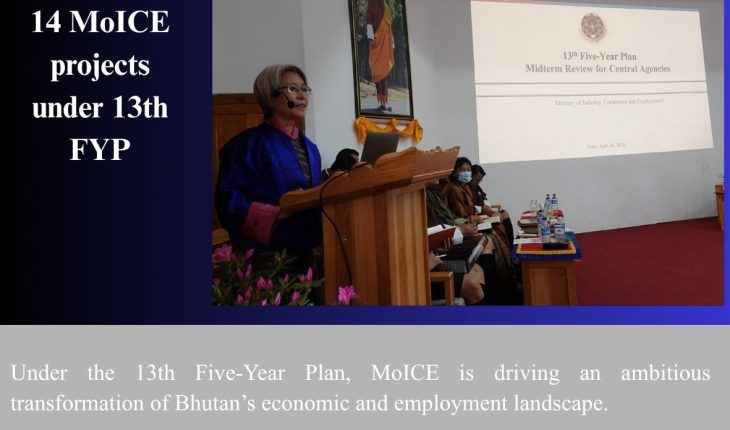
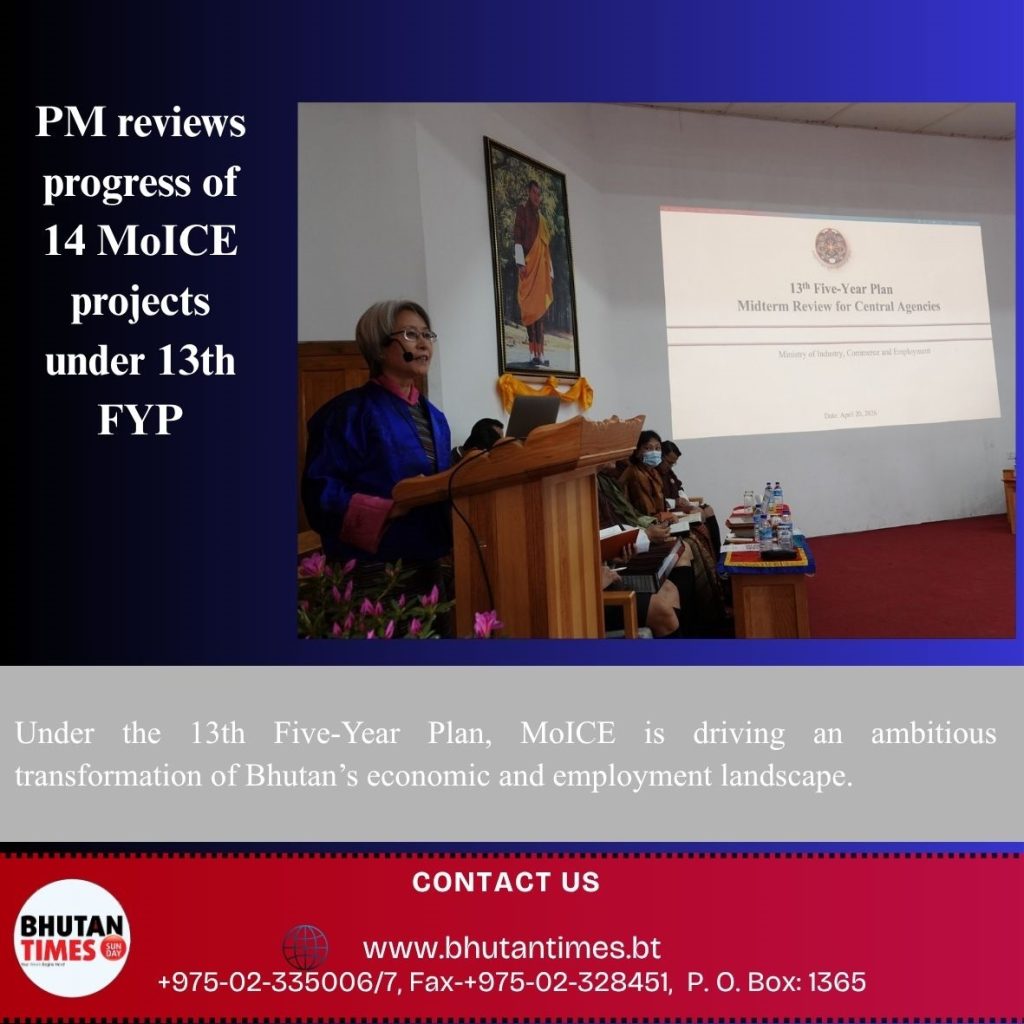
The Ministry of Industry, Commerce and Employment (MoICE) has reported the implementation status of 14 projects under Bhutan’s 13th Five-Year Plan, outlining progress across 56 identified activities.
During the Mid – Term Review for the ministry held on 20 April, only 1 activity has been fully completed so far.
The bulk of the work 52 activities is currently ongoing, indicating that most components of the projects are still under implementation while 3 activities have not yet commenced.
The Ministry also provided a breakdown of funding commitments linked to these activities. Out of the total, 3 activities have secured full funding commitments.
A significantly larger portion, 47 activities, are being carried out with partial funding commitments. In addition, 2 activities are being undertaken by the Ministry without any committed funding.
The three activities yet to begin include the establishment of a special window or channel to attract and facilitate investment from Bhutanese residing abroad, strengthening support mechanisms for industries, and developing strategies for the integration of domestic industries into global value chains.
During the MTR, Prime Minister Tshering Tobgay raised concerns regarding the delay in initiating the activity related to establishing a dedicated investment facilitation window for Bhutanese living abroad.
Questioning the Ministry, the PM stated that the initiative appeared straightforward in its scope and asked why it had not yet been started.
“I thought establishing a special window channel to attract and facilitate investment for Bhutanese residing abroad would be simple. Why has it not started yet?” PM said, noting that the initiative essentially involved setting up a dedicated office or mechanism.
The discussion also extended to the broader role of Bhutanese living abroad and their potential contribution to national development.
In this context, the Prime Minister referred to Tandin Dorji, Founder and Director of Education Pro consultancy, acknowledging his role in facilitating opportunities for Bhutanese youth and civil servants to pursue education and employment in Australia.
The PM noted that such initiatives had created pathways for Bhutanese to gain international exposure and employment. Drawing a parallel, he highlighted the importance of engaging Bhutanese abroad who may wish to return and contribute to the country.
PM also stated that similar efforts should be made to inform and guide Bhutanese overseas about opportunities available within the country.
He also emphasized the need to communicate clearly the prospects and challenges for those considering returning to Bhutan.
In particular, he pointed to opportunities emerging in the Gelephu Mindfulness City, as well as other sectors within the country, where returning Bhutanese could potentially contribute their skills and experience.
The PM further directed the Ministry to engage with Tandin Dorji to seek guidance on how best to reach out to Bhutanese living abroad and provide them with relevant information on opportunities in Bhutan.
He said such engagement could help in better understanding how to support returning Bhutanese and align their skills with national priorities.
At the same time, PM clarified that returning Bhutanese would not automatically be provided with employment opportunities by the government.
Instead, he stated that the role of the Ministry would be to guide, train, and inform individuals about available opportunities and sectors where they could contribute.
He emphasized that the Ministry should focus on building systems that help returning Bhutanese navigate the domestic landscape, including identifying areas of demand, understanding market conditions, and accessing relevant support mechanisms.
The review highlighted both the progress and the challenges in implementing the 14 projects under the 13th Five-Year Plan.
While a large number of activities are underway, the limited number of completed activities and the presence of projects yet to begin indicate areas requiring further attention.
In terms of financing, the Ministry has secured funding from nine sources, including the Economic Stimulus Programme (ESP). The total funding envelope amounts to Nu 50,458.4 billion, of which Nu 30,320 billion has been mobilised through the ESP.
Despite these commitments, a resource gap remains. Including the ESP, the financing shortfall stands at Nu 50,451 billion. Excluding the ESP, the resource gap increases to Nu 70,216 billion.
The funding structure also reflects a reliance on partial commitments for the majority of activities, with only a small number fully funded.
Additionally, the Ministry’s decision to proceed with certain activities without committed funding points to ongoing efforts to maintain implementation momentum despite financial constraints.
The discussion underscored the importance of timely execution, effective coordination, and resource mobilization to ensure the successful delivery of planned outcomes under the 13th Five-Year Plan.