RENUKA RAI | Thimphu
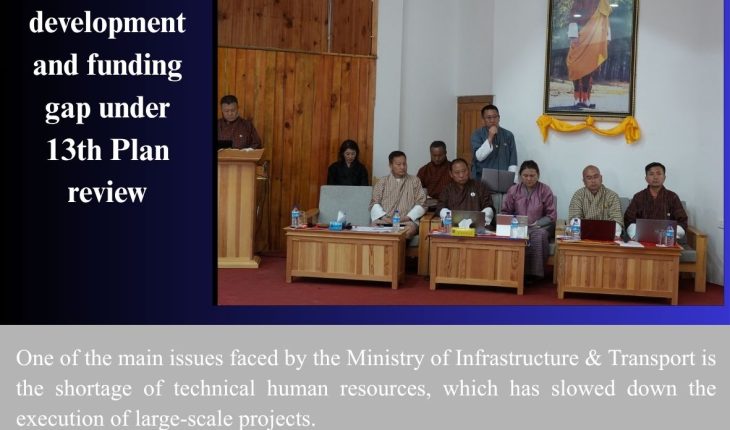
The government has reassessed its infrastructure development plans and priorities as part of the Mid-Term Review (MTR) of the 13th Five-Year Plan, highlighting both progress and ongoing challenges in implementing major projects across the country.
The review, chaired by Prime Minister Tshering Tobgay, focused on the performance of the Ministry of Infrastructure and Transport (MoIT), which is responsible for improving connectivity and enhancing the liability of urban areas.
During the review, the ministry presented updates on key infrastructure projects, including roads, bridges, railways, water supply, and urban development.
While progress has been made in several areas, the ministry also reported challenges such as funding gaps, shortage of skilled professionals, and rising construction costs.
One of the major highlights of the review was progress in national connectivity.
The ministry has completed Detailed Project Reports (DPRs) for two proposed railway links Gelephu–Kokrajhar and Samtse–Banarhat. These projects are expected to improve regional connectivity in the future.
Road construction is also ongoing, with four new highways covering 140 kilometres currently under development. In addition, eight highway improvement projects spanning 194 kilometres are in progress.
The ministry reported that 230.5 kilometres of dzongkhag roads have been improved and surfaced, helping to enhance access in different parts of the country. Five major bridges, with a total length of 382 metres, have also been completed to connect communities.
These developments are part of the government’s effort to strengthen transport networks and improve connectivity within Bhutan.
In Thimphu, the ministry has been working to improve urban liveability through the expansion of green and open spaces. New and improved public parks are being developed to enhance the quality of life for residents.
Urban planning efforts are also progressing. Six Local Area Plans (LAPs) have been completed, while two more are currently under preparation. These plans are expected to guide the growth and development of urban areas.
The Green Infrastructure and Open Spaces project in Thimphu is also underway, although it is still in the early stages of implementation.
The ministry reported improvements in water supply coverage across the country. Basic water supply has now reached 87 percent, while safely managed water services stand at 66 percent.
To further improve water access, the government has increased the budget for water supply from Nu 2.85 billion to Nu 3.14 billion. However, the budget for quality improvement has been reduced from Nu 200 million to Nu 100 million.
In partnership with the Ministry of Agriculture and Livestock, 23 irrigation projects are currently being implemented at different stages. These projects aim to support agriculture and improve water availability for farming.
The ministry has also proposed several new infrastructure projects as part of the revised plan. These include a Sanitation Flagship Programme worth Nu 2.5 billion, the reconstruction of the Woobjilum intake, the Relangthang–Shechamthang road project, and safety works at Bumthang Airport.
Under the Bhutan Construction and Transport Authority, additional initiatives have been proposed, such as improving data systems, installing road safety equipment, and outsourcing certain services. These proposals are aimed at strengthening infrastructure systems and addressing existing gaps.
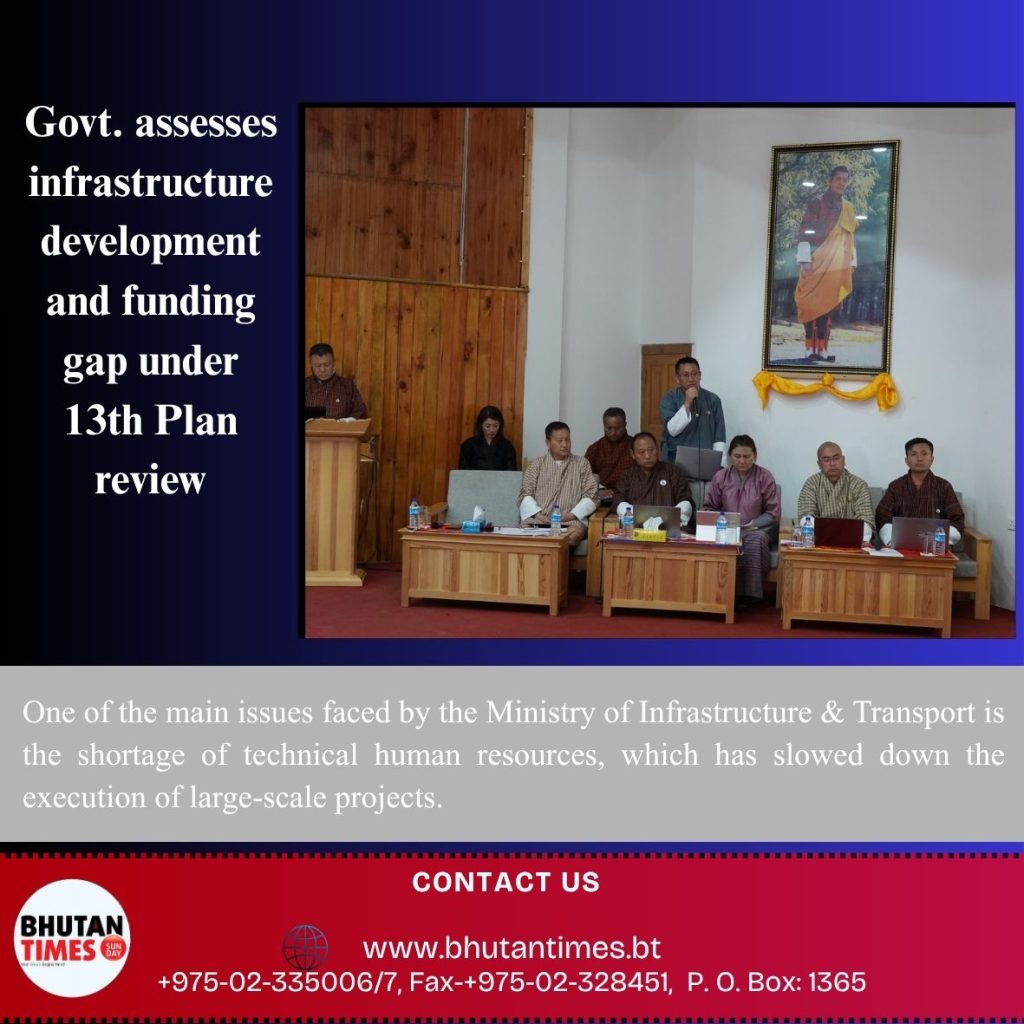
Despite the progress, the ministry highlighted several challenges that continue to affect project implementation. One of the main issues is the shortage of technical human resources, which has slowed down the execution of large-scale projects.
Other challenges include limited equipment, delays in obtaining clearances, land-related issues, high construction costs, and coordination gaps between agencies. Budget constraints and staff attrition are also affecting the pace of work.
The ministry reported a major funding gap, including a shortfall of Nu 7.35 billion in the surface transport sector. There are also deficits in roads and water supply.
External factors are adding to the pressure. Rising fuel prices, influenced by the situation in West Asia, are increasing transport and construction costs. This is affecting project timelines and overall budgets.
To address these issues, the ministry plans to strengthen monitoring and evaluation through field visits and regular progress reviews.
It also aims to improve coordination among agencies, prioritise maintenance funding, build technical capacity, and streamline clearance processes. The ministry is also exploring innovative financing options to support infrastructure development.
PM emphasised the importance of completing priority projects within the current plan period. He called on the ministry to accelerate work and ensure that projects are delivered on time.
He also stressed that the quality of infrastructure must be given top priority. According to the Prime Minister, strong quality control and monitoring systems are necessary, especially for roads and bridges.
“If the ministry lacks technical capacity or human resources, we may have to set up a dedicated project unit,” he said.
The PM also inquired about the progress of the Government Office Complex and the Hejo crematorium projects, which are currently being reassessed. He directed the ministry to expedite these projects.
At the same time, he acknowledged the efforts of the ministry and commended its achievements so far, while encouraging officials to work harder to meet the targets of the 13th Plan.
The ministry reported that it has utilised Nu 7.59 billion so far, which is about 18.03 percent of the total Nu 49.58 billion allocation under the 13th Five-Year Plan.
In terms of progress, 19 activities have been completed, while 94 are currently ongoing. Fifteen activities have not yet started, and 29 are being implemented outside the plan framework.
The Department of Surface Transport has the largest share of the budget, with Nu 37.45 billion allocated, including funding for Project DANTAK.
Several major projects are currently at different stages of implementation. The Rinchending Bypass Road is more than half complete, while the Sherichhu bridge is still in the early stages.
Flood protection works in Gelephu and urban development projects in Thimphu are also ongoing.
In the aviation sector, Gelephu Airport has been upgraded to international status. Works at Paro Airport are continuing, including apron development and other infrastructure improvements.
With the 13th Five-Year Plan set to end in 2029, the government aims to improve productivity and support economic growth through better infrastructure and connectivity.
The review highlighted the need to address existing gaps while maintaining progress on key projects. It also stressed the importance of improving coordination, strengthening capacity, and ensuring efficient use of resources.
As the government continues to implement its infrastructure plans, the focus will remain on delivering projects that support development while overcoming challenges related to funding, capacity, and rising costs.