KARMA CHOGYEL YOEZER | Thimphu
For barbers in Thimphu, the job is no longer just about giving a quick haircut.
Over the years, the barber shop has slowly changed from a simple place for basic cuts into a space where people come for style, comfort, cleanliness, and confidence.
Many barbers say the biggest change is in what customers expect. In the past, most people asked for a simple short haircut or a regular trim. Today, customers, especially young people, often walk in with photos saved on their phones.
Some want a fade, some want their beard shaped, while others ask for hair setting, colouring, or a more fashionable look.
Sonam Jamtsho, 42, a barber in Thimphu said, “Customers today know exactly what they want. Some show us pictures from social media and ask us to make it look the same. Before, people were happy with a normal haircut, but now they want proper style, clean finishing, and a fresh look.”
This change has pushed barbers to keep learning. A barber can no longer depend only on old methods. They have to understand new hairstyles, different hair textures, face shapes, and customer preferences.
Many customers also expect barbers to suggest what suits them best, which means communication has become an important part of the work.
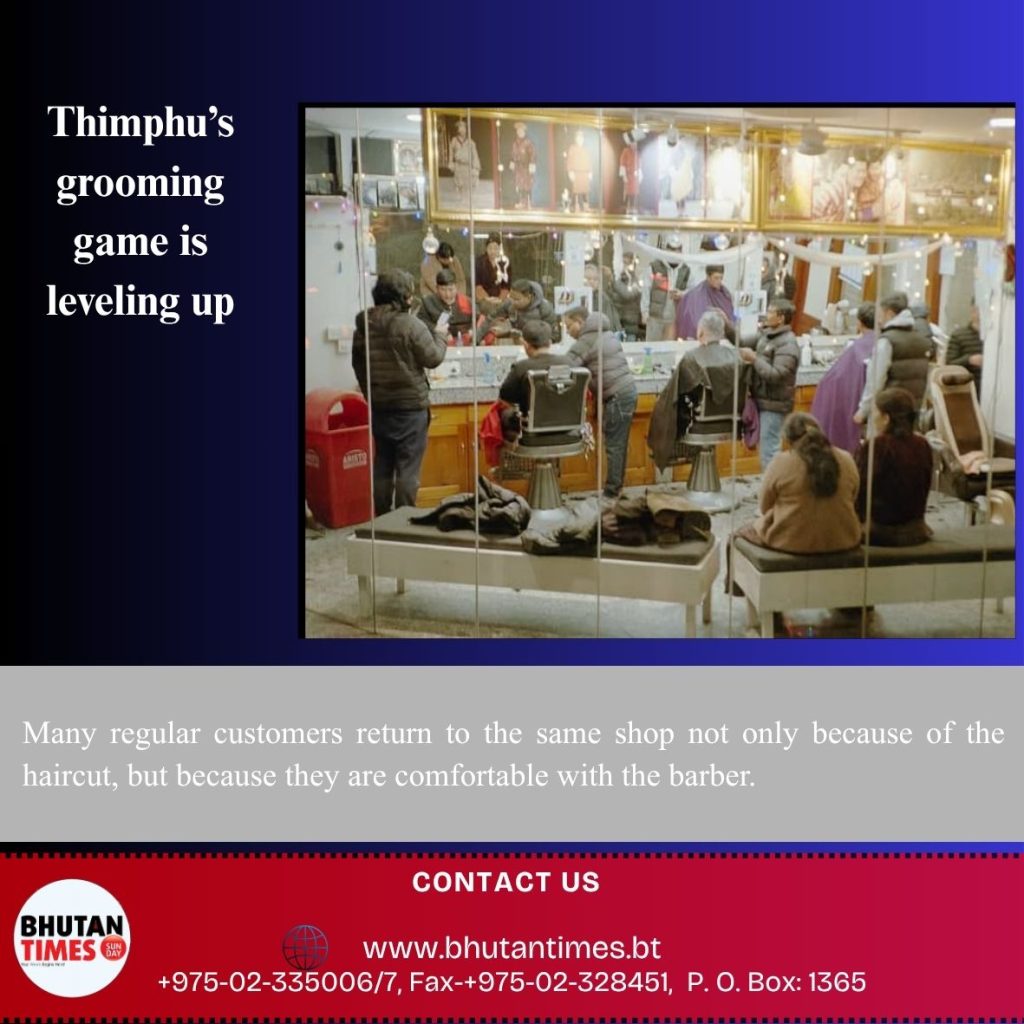
The relationship between barbers and customers has also become closer. Many regular customers return to the same shop not only because of the haircut, but because they are comfortable with the barber.
Over time, a barber comes to know a customer’s preferred style, how short they like their hair, and even how they like to be treated.
Another barber Pema Yeshi, 35, said, “For regular customers, we already know what they want. Some don’t even need to explain much. They come back because they trust us. That trust is very important in this work.”
Cleanliness has also become a major part of the profession. Customers now notice whether the shop is clean, whether the tools are properly kept, and whether fresh blades and clean towels are used. Barbers say hygiene is no longer something extra; it has become part of the service itself.
“People feel more comfortable when they see that the shop is clean, and a good haircut is important, but customers also want clean tools, clean chairs, and proper care. If the shop is not clean, they may not come back,” he added.
Competition has also increased in Thimphu. With more barber shops opening in different parts of the city, customers have more choices than before. This has made barbers work harder to improve their services.
Some shops now offer hair washing, beard trimming, head massage, home service, and modern styling. Others try to attract customers through affordable prices, quick service, or a friendly atmosphere.
Social media has also changed the way barbers do business. Earlier, most customers came through word of mouth or because the shop was in a busy location.
Today, many barbers post haircut photos, short videos, and contact details on Facebook, Instagram, and TikTok. For some shops, online visibility has become almost as important as the signboard outside the shop.
Another barber Dawa Tshering Sherpa said, “When customers like the haircut, they sometimes post it online or tell their friends. That helps us get more customers. These days, even a small barber shop has to show its work properly.”
But the changes have also brought pressure. Running a barber shop in Thimphu is becoming more expensive.
Rent, electricity, equipment, blades, towels, hair products, and cleaning materials all add to the cost. Good clippers, scissors, mirrors, chairs, and styling products are not cheap. Because of this, some barbers say price increases are sometimes necessary.
“People ask why haircut prices are going up, but they do not always see the costs behind it. Everything has become expensive. If we want to give better service, we also have to spend more,” he added.
From the outside, a haircut may look simply. But barbers say the work requires patience, skill, and long hours of standing.
They have to deal with different types of customers, listen carefully, and make sure each person leaves satisfied. During busy hours, the work can be tiring, but barbers say customer satisfaction keeps them motivated.
Despite the challenges, many barbers take pride in their profession. For them, barbering is not just a way to earn money. It is a skill that gives them independence and a chance to build their own business.
Some say the profession is becoming more respected as people begin to understand the effort and creativity involved.
The image of the barber is also changing. Earlier, some people may have seen barbering as a basic trade. Today, it is becoming part of Thimphu’s growing urban lifestyle.
A barber is now not only a person with scissors and clippers, but also a stylist, listener, small business owner, and service provider.
As Thimphu continues to grow, barber shops are likely to keep changing. Customers will expect better styles, cleaner spaces, convenient services, and professional behaviour. For barbers, this means they must continue learning and adapting.
The barber chair may still look the same, but the work around it has changed. For Thimphu’s barbers, the evolution of their trade is not only about fashion. It is about hard work, dignity, customer trust, and keeping up with a city that is changing every day.