KINLEY KHANDU CHODEN | Thimphu
The Ministry of Education and Skills Development (MoESD) has reported a mix of progress and implementation challenges under the 13th Five-Year Plan (13th FYP), according to updates presented at a mid-term review meeting chaired by Prime Minister Tshering Tobgay.
The ministry has completed two planned activities under the FYP, while 29 are ongoing and four have yet to begin.
Additionally, of the ongoing initiatives, 8 are fully funded, 21 partially funded, and three remain without committed financial resources, Education Secretary Tshewang Chophel Dorji said during the review.
In terms of infrastructure, 97.1 percent of schools now meet safe drinking water standards. The ministry reported the completion of 15 water supply schemes and 40 standard toilets, alongside the installation of water filters in 215 schools.
A 2023 assessment found most schools compliant with World Health Organization (WHO) Water, Sanitation and Hygiene (WASH) standards.
The ministry is also working toward upgrading 518 schools to Common Minimum Facilities (CMF) standards, which include sanitation, sports infrastructure, digital tools, furniture and transport.
Further, a Nu 800 million budget has been proposed for sports infrastructure development.
Student support programmes have expanded during the plan period. The student stipend has increased from Nu 1,500 to Nu 3,100, while the One Child One Egg programme now covers 345 schools, benefiting 31,579 students.
A total of 8,608 students has been identified for need-based assistance covering essentials such as uniforms, stationery and bedding.
However, Prime Minister Tshering Tobgay called for the establishment of national guidelines to better support economically disadvantaged students.
In skills development, 30,170 individuals have participated in structured training programmes as of March 2024, against a national target of 125,000.
TVET capacity has also expanded from 900 to 3,000 seats annually. Two diploma programmes have been introduced in partnership with ITE Education Services, Singapore.
Nonetheless, female participation in TVET remains at 33.2 percent, below the 40 percent target.
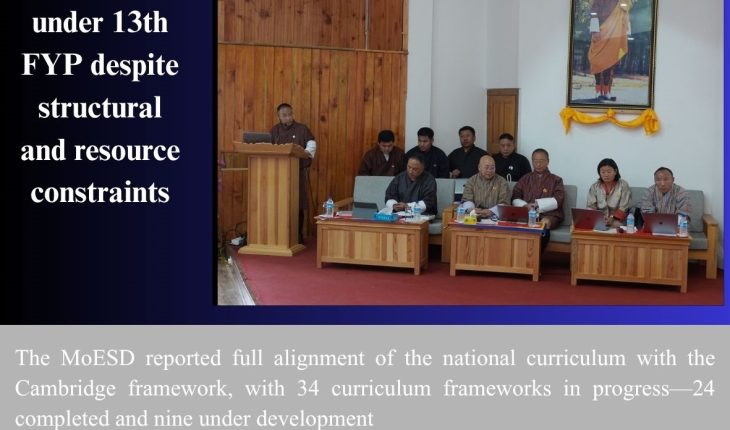
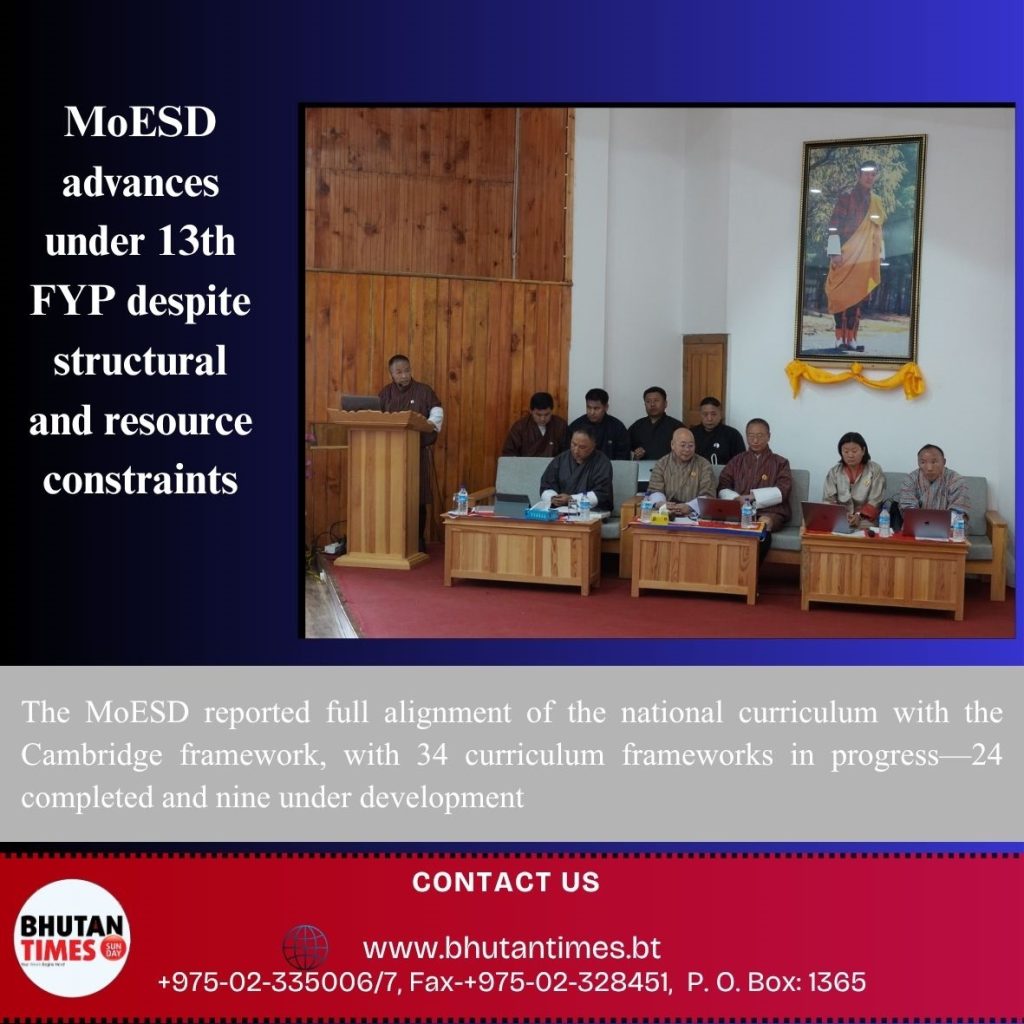
Education reforms are also underway. The ministry reported full alignment of the national curriculum with the Cambridge framework, with 34 curriculum frameworks in progress—24 completed and nine under development.
Revised textbooks are expected to be rolled out in phases by 2027, while national examinations are being restructured in line with Cambridge standards.
Grade XII examination reforms are scheduled for December 2027, followed by Grade X reforms in 2028.
In higher education, ten institutions have received accreditation, while the Bhutan Qualifications and Professionals Certification Authority is piloting quality assurance systems.
Teacher attrition remains a concern. Between 2020 and 2025, 5,516 teachers resigned while 3,619 were recruited, resulting in a shortage of 1,897 teachers. The Prime Minister urged stronger support systems to ensure teachers feel valued, particularly in dzongkhag schools.
“Teachers must be made to feel valued and important by the dzongdag, dzongkhag administration, local authorities and the wider community,” the PM said.
Despite staffing challenges, professional development programmes continue. About 7.5 percent of teachers have been trained under the 2025 Education Technology Framework.
In addition, 2,911 teachers participated in immersion programmes in India, while 144 counsellors received training on substance use prevention.
In addition, social-emotional learning programmes have also been implemented in 566 schools.
In TVET institutions, 43.88 percent of faculty meet ICT standards, while 73 percent are certified in technical delivery.
Student performance data shows average scores of 71.7 in Grade VI, 60.1 in Grade X, and 57.0 in Grade XII examinations.
International exposure programmes have included participation from 13 countries, although enrolment remains below the target of 500 students.
The total outlay for the 13th FYP stands at Nu 33.36 billion, of which Nu 18.92 billion has been secured. Between 2024 and 2026, expenditure reached Nu 3.59 billion, reflecting a 44.49 percent absorption rate.
Key allocations include Nu 5,145 million for central and cluster schools, Nu 430 million for Cambridge-aligned examinations, Nu 258.24 million for support to disadvantaged students, and Nu 5 million for rural skills development programmes.
While the ministry has reported steady gains in infrastructure, curriculum reform and skills expansion, funding gaps and a persistent teacher shortage continue to weigh on implementation under the 13th FYP.