RENUKA RAI | Thimphu
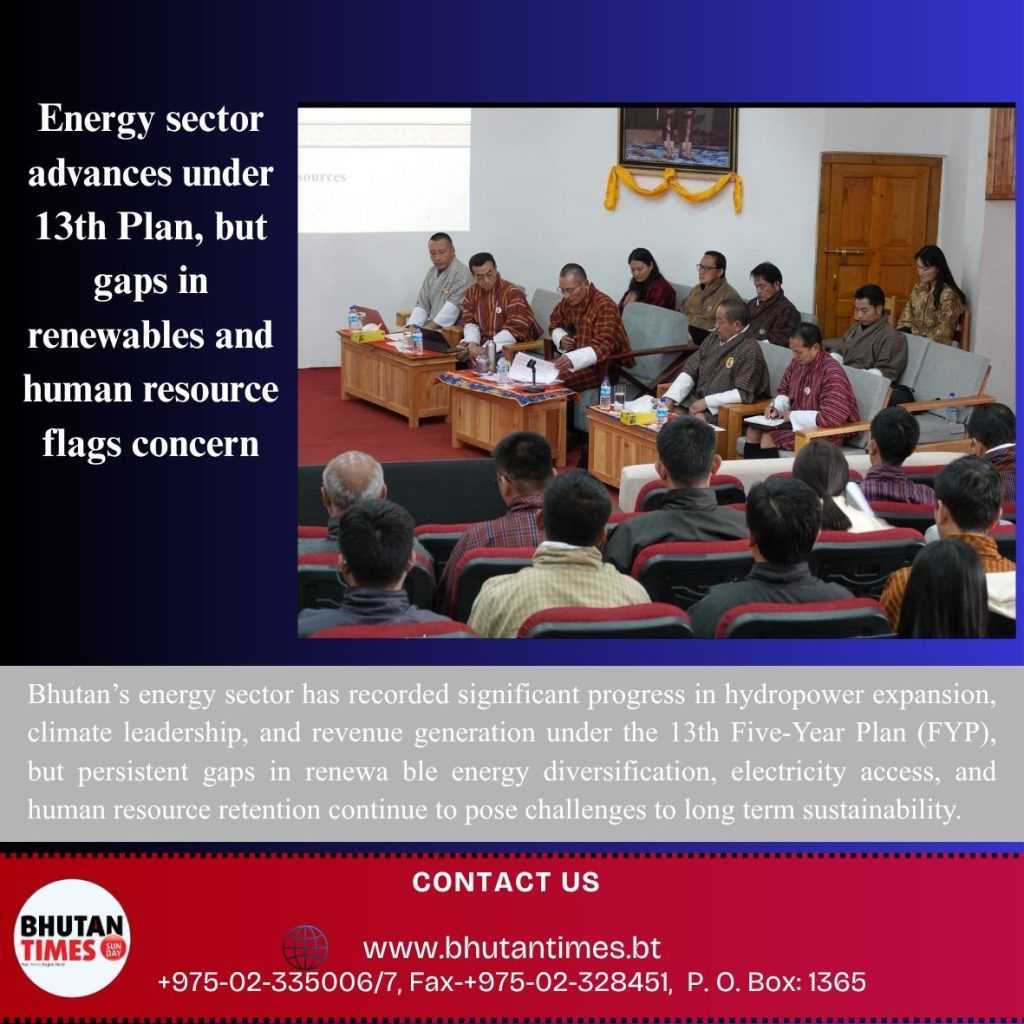
Bhutan’s energy sector has recorded significant progress in hydropower expansion, climate leadership, and revenue generation under the 13th Five-Year Plan (FYP), but persistent gaps in renewable energy diversification, electricity access, and human resource retention continue to pose challenges to long-term sustainability.
These issues were highlighted during the Mid-Term Review (MTR) of the Ministry of Energy and Natural Resources (MoENR), held on April 20 and chaired by Prime Minister Tshering Tobgay.
The review focused on maintaining momentum while realigning national priorities to respond to emerging economic and global challenges.
The session underscored hydropower as the backbone of Bhutan’s economy, with major projects moving steadily into implementation.
Construction has begun on three large hydropower projects Khorlochhu (600 MW), Dorjilung (1,125 MW), and Wangchhu (570 MW) in addition to the ongoing Punatsangchhu-I project, which has a capacity of 1,200 MW.
Complementing these are smaller hydropower developments that have already been completed and commissioned.
The Suchhu (18 MW), Burgangchhu (54 MW), and Yungichhu (32 MW) projects are now contributing to domestic supply and export capacity.
The ministry also plans to expand its hydropower pipeline further, including the development of pumped storage projects, as part of its long-term goal to achieve 20 gigawatts (GW) of installed capacity.
However, officials acknowledged that achieving this target would require an estimated USD 26 billion in investment, making financing one of the most significant challenges facing the sector.
While hydropower continues to dominate Bhutan’s energy landscape, progress in renewable energy diversification has been uneven.
MoENR Secretary Karma Tshering reported that solar energy capacity has reached 32.49-megawatt peak (MWp), representing only seven percent of the ambitious 467 MWp target.
Wind energy development remains at a nascent stage, with only a 0.6 MW baseline currently in place. Despite this, the ministry has completed a Detailed Project Report for a 30 MW wind project and is working to revise its targets upward.
Despite the slow progress, some milestones have been achieved. The 22.38 MW Sephu Solar Project was commissioned in phases in 2025, while construction has begun on the 120 MW Jamjee Solar Project.
Rooftop solar installations have been rolled out to more than 300 households, and mini-grid systems have been introduced in remote areas such as Lunana, improving access to electricity in isolated communities.
The ministry has proposed scaling up its renewable energy ambitions, including increasing the solar target from 467 MWp to 1,000 MWp, alongside revisions to wind energy goals.
On the climate front, Bhutan continues to strengthen its global leadership. The National Carbon Registry is now operational, and a National Climate Measurement, Reporting, and Verification (MRV) system is under development.
The government also launched its Nationally Determined Contribution (NDC 3.0) in October 2025 and submitted it to the United Nations Framework Convention on Climate Change, committing to reduce emissions to 12,507.36 gigagrams of CO2 equivalent by 2030.
The ministry reported strong performance in climate financing and carbon trading, exceeding targets by more than 200 percent. It raised Nu 10.9 billion against an initial target of Nu 5.3 billion, reflecting growing opportunities in carbon markets.
Natural resource management also contributed significantly to revenue generation. The ministry reported earning Nu 1.8 billion from timber sales, including Nu 482.56 million generated through scientific forest thinning practices.
Despite these achievements, several performance indicators reveal underlying gaps. The energy sector has achieved only 70 percent of its GDP output target, generating Nu 39.17 billion against a goal of Nu 55.99 billion.
Expansion of electricity access has also been limited, reaching just 21 percent of the target, highlighting ongoing challenges in extending services to remote and rural communities.
Efforts to reduce fossil fuel consumption have similarly fallen short, achieving only three percent against a target of ten percent.
Measures such as distributing 870 induction cookstoves and installing solar water heating systems have been introduced, but their overall impact remains modest.
PM Tshering Tobgay emphasised the need for Bhutan to strengthen its energy security in an increasingly uncertain global context.
“Bhutan must focus on long-term energy security, especially in light of global geopolitical uncertainties,” he said.
Drawing lessons from ongoing conflicts in the Middle East, the Prime Minister noted that many countries face vulnerabilities in both fossil fuel and electricity supply systems.
“While many countries face vulnerabilities in both fossil fuel and electricity supply during conflicts, Bhutan remains relatively secure due to its hydropower resources,” he said.
However, he stressed that this advantage must be complemented by efficient energy use and forward planning.
“We must not only reduce fossil fuel consumption but also promote efficient use of electricity and carefully assess our future energy demand,” he added.
Electricity reliability has improved in recent years. The System Average Interruption Duration Index (SAIDI) has been reduced to 2.32 hours per month, surpassing targets.
However, the System Average Interruption Frequency Index (SAIFI) remains below expected performance levels, indicating that outages still occur more frequently than desired.
The PM pointed out that even in the capital, reliability remains an issue. “Even in Thimphu, which is considered one of the most reliable areas, power outages occur more than twice a month. This is something we must address,” he said.
Beyond infrastructure and policy challenges, the review brought attention to a growing human resource concern within the ministry.
A total of 73 staff members is currently on Extraordinary Leave (EOL), deputation, secondment, or long-term training, creating gaps in institutional capacity.
The PM described the situation as a “human resource vacuum” and called for urgent attention.
“We are facing a serious human resource vacuum. We must understand why our civil servants are leaving and create a working environment where they feel valued, motivated, and proud to serve,” he said.
He also stressed the need for data-driven analysis to address the issue. “There is a need for deeper analysis of RCSC data on resignations following EOL so that we can address the root causes of talent loss,” he added.
Calling on leadership within the ministry, he said, “Senior management must take responsibility to restore the sense of pride that was once associated with joining the civil service.”
The issue reflects broader concerns about retention and morale in Bhutan’s public sector, particularly as more professionals explore opportunities outside the civil service.
On the policy front, the ministry reported substantial progress. Key frameworks such as the National Energy Policy 2025, Renewable Energy Development Roadmap 2024, and National Solar Energy Roadmap (2025–2040) have been approved.
A Hydrogen Roadmap and Domestic Tariff Guidelines have also been developed, while the Energy Bill is currently under stakeholder consultation.
These initiatives are expected to strengthen regulatory governance and guide the sector toward a more diversified and resilient energy future.
In his closing remarks, PM expressed satisfaction with the overall progress of the 13th FYP but emphasised the need for greater ambition.
“Tourism and energy are the crown jewels of our economy, and we must reflect their importance by setting higher targets and ambitions,” he said.
He directed the ministry to consider revising its key performance indicators upward to reflect the critical role of energy in Bhutan’s economic future.
The MTR ultimately presents a picture of an energy sector at a pivotal stage—marked by strong achievements in hydropower and climate action, but also facing structural challenges that require urgent and sustained attention.