KINLEY KHANDU CHODEN | Thimphu
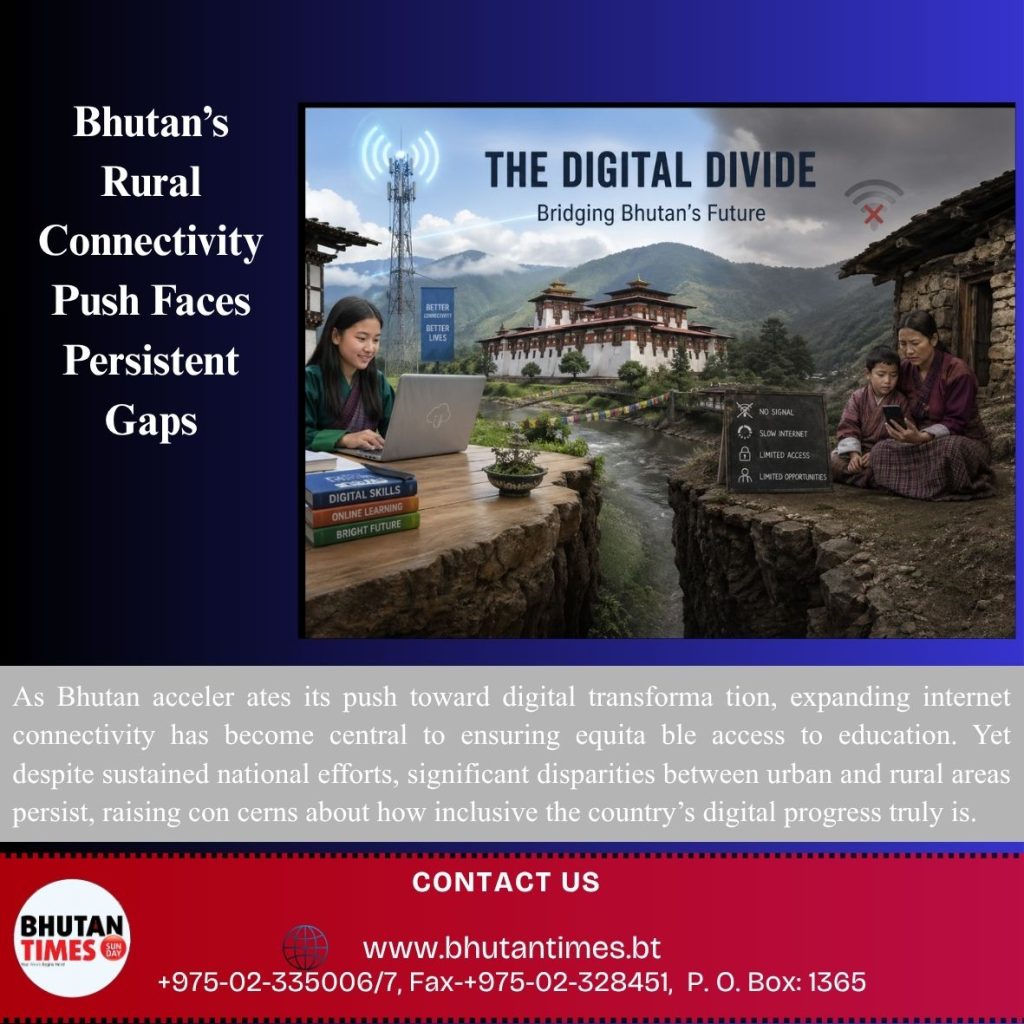
As Bhutan accelerates its push toward digital transformation, expanding internet connectivity has become central to ensuring equitable access to education. Yet despite sustained national efforts, significant disparities between urban and rural areas persist, raising concerns about how inclusive the country’s digital progress truly is.
At the forefront of this effort is the Bhutan InfoComm and Media Authority (BICMA), the country’s telecommunications regulator, tasked with improving connectivity across Bhutan, particularly in remote and hard-to-reach communities.
Through its Rural Communication Programme, BICMA has worked to extend basic communication services to rural households across all dzongkhags. According to BICMA responses, the initiative has led to improvements in connectivity coverage, bringing previously unconnected communities into the network.
In a written response, BICMA said, “BICMA has been implementing a series of Rural Communication Programmes to provide the facilities and services in rural areas across all the dzongkhags. This has helped to connect and improve the services in most of the rural areas.”
A key component of the programme has been the gradual upgrading of network technology, shifting from basic voice services to mobile broadband.
“Through the Rural Communication Programme, we have successfully established basic communication services and subsequently upgraded from 2G voice to 4G mobile broadband across rural households,” BICMA stated. “By expanding 4G access, we are significantly improving rural connectivity, enabling students and teachers to access vital online learning resources.”
Despite these gains, connectivity in rural Bhutan continues to face structural challenges that extend beyond infrastructure rollout. BICMA acknowledged in its responses that geography remains one of the biggest barriers.
“Delivering reliable network connectivity remains challenging due to high costs relative to population density and the country’s difficult geography,” BICMA stated. “The project is also subject to the availability of the fund (Universal Service Fund).”
Bhutan’s mountainous terrain and scattered settlements make the installation and maintenance of telecommunications infrastructure both complex and costly. In many areas, limited population density reduces the commercial viability of network expansion, further complicating efforts to deliver consistent service.
As a result, coverage does not always translate into reliable user experience. While networks may be available, service quality can vary, with issues such as speed and stability affecting usability.
BICMA responses pointed to progress in some of the most remote regions of the country.
“We have achieved 2G/4G coverage across all permanent households in areas like Laya and Narang through the Rural Communication Programme,” BICMA said. “Most seasonal herding areas are also covered, despite their sparse and temporary populations.”
However, the authority acknowledged in its responses that complete coverage has not yet been achieved.
“A few locations remain excluded due to minimal residency and prohibitive infrastructure costs,” BICMA noted. “These areas will be addressed gradually based on strategic priority.”
The emphasis on “strategic priority” reflects the practical limitations faced by policymakers. With finite resources, decisions on infrastructure investment must balance cost, impact, and feasibility, often leaving the most remote communities waiting longer for reliable connectivity.
Funding remains a key constraint. Much of the expansion depends on the Universal Service Fund, which supports telecommunications services in underserved areas.
“The project is subject to the availability of funds from the Universal Service Fund,” BICMA responses reiterated.
At the same time, the increasing reliance on digital platforms for education has heightened the urgency of addressing connectivity gaps. Uneven internet access risks widening disparities as students depend more on online learning resources.
BICMA responses maintain that expanding 4G access is a critical step toward narrowing this divide.
“By expanding 4G access, we are significantly improving rural connectivity, enabling students and teachers to access vital online learning resources,” BICMA said.
However, the distinction between access and quality remains significant. While coverage may be widespread, the effectiveness of that connectivity depends on consistent speed and reliability—factors that continue to challenge rural networks.
BICMA’s approach, as reflected in its responses, follows a phased strategy: first establishing basic connectivity, then gradually improving quality and expanding reach. This incremental model aligns with the logistical realities of Bhutan’s terrain and the financial constraints of large-scale infrastructure development.
As Bhutan continues its digital transition, the challenge will be ensuring that improvements in connectivity keep pace with growing demand, particularly in the education sector where reliable internet access is increasingly essential.
For now, BICMA responses indicate steady progress while underscoring the complexity of bridging the country’s digital divide. Expanding connectivity across mountainous terrain is not only a technical undertaking but also an economic one.
Whether these efforts ultimately succeed in narrowing the gap between urban and rural communities will depend on sustained investment, careful prioritisation, and the ability to translate coverage into meaningful, reliable access.