RENUKA RAI Thimphu
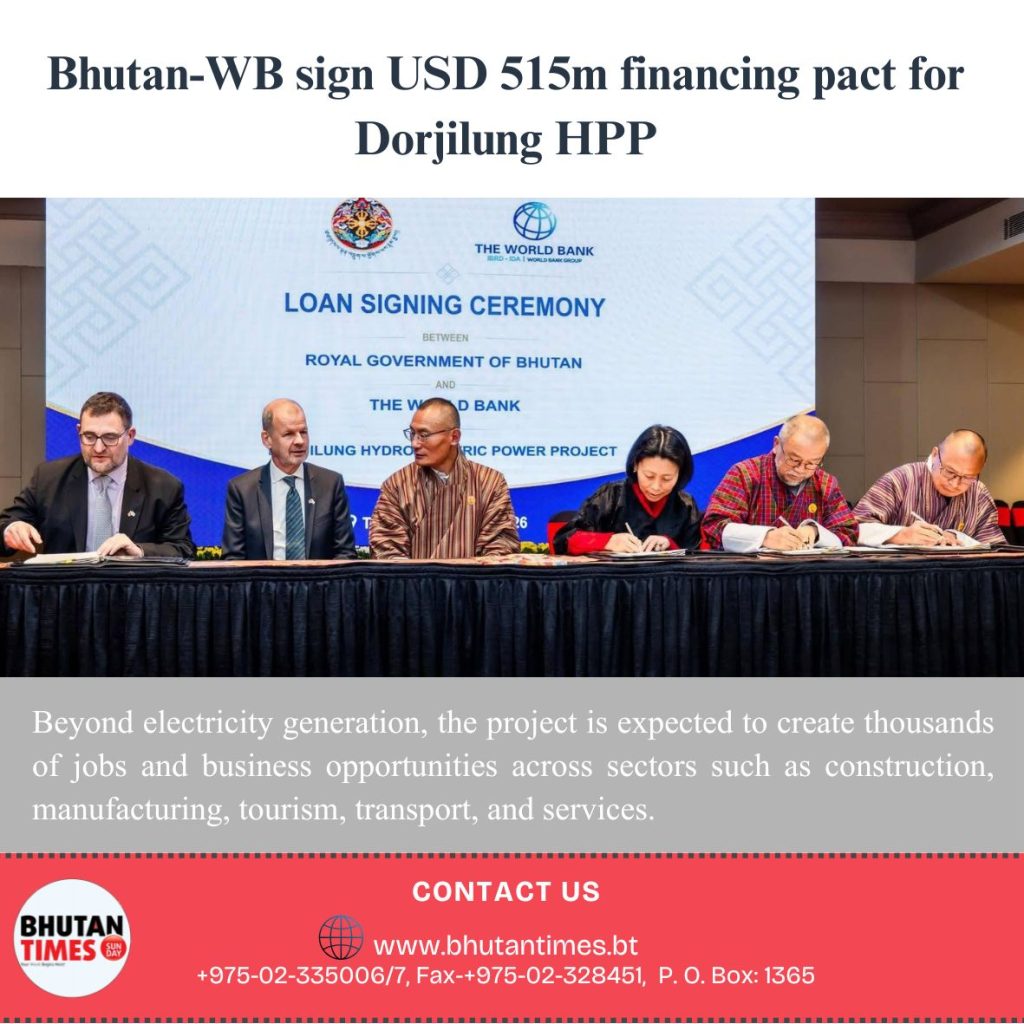
Bhutan and the World Bank have signed financing agreements worth USD 515 million for the 1,125 MW Dorjilung Hydroelectric Power Project, a landmark initiative expected to transform the country’s energy sector, strengthen economic growth, and deepen regional clean energy cooperation with India.
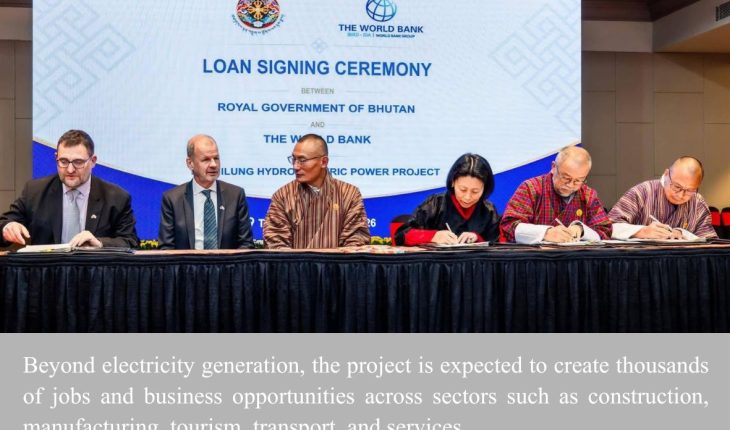
Signed in Thimphu on May 5, the agreements mark a major milestone for Bhutan’s largest hydropower project to be developed under a public-private partnership model.
Once completed, the project is expected to contribute nearly one-third of Bhutan’s total electricity generation capacity and significantly reshape the country’s economic outlook.
The project, located on the Kurichhu River in eastern Bhutan, will generate more than 4,500 GWh of clean electricity annually.
The officials say it will help address Bhutan’s seasonal energy shortages during winter while enabling surplus electricity exports to India during the summer and monsoon seasons.
The agreements were signed between the Royal Government of Bhutan and the World Bank Group in the presence of Prime Minister Tshering Tobgay and World Bank South Asia Region Vice President Johannes Zutt.
PM described the Dorjilung project as a cornerstone of Bhutan’s 13th Five-Year Plan and one of the country’s most important infrastructure investments.
“The Dorjilung Hydroelectric Power Project is a cornerstone of Bhutan’s 13th Five-Year Plan and will be the Kingdom’s largest hydropower project developed under a public-private partnership,” the PM said.
“This transformational investment will supply clean energy, spur economic growth, and advance our carbon-negative commitment.”
The PM added that the project reflects the strong partnership between Bhutan and the World Bank Group and their shared vision for a sustainable and prosperous future.
According to the government and the World Bank, the hydropower plant is expected to increase Bhutan’s GDP by approximately 2.4 percent through direct and indirect economic activity.
Beyond electricity generation, the project is expected to create thousands of jobs and business opportunities across sectors such as construction, manufacturing, tourism, transport, and services.
Reliable and affordable electricity is also expected to support industrial growth and strengthen small businesses, while export revenues generated from surplus electricity sales to India could provide additional resources for public investments in health, education, and infrastructure.
The project also carries major environmental significance. Officials estimate it will displace approximately 3.3 million tons of carbon dioxide emissions annually by replacing fossil-fuel-based energy generation in the region.
Bhutan, already known globally as a carbon-negative country, sees the project as central to maintaining that status while expanding its role in regional clean energy trade.
World Bank South Asia Vice President Johannes Zutt said the Dorjilung project introduces a new model for infrastructure financing in Bhutan by combining public and private sector capital.
“The Dorjilung Hydroelectric Power Project involves an innovative financing model, which brings together public and private capital and sets a new standard for sustainable infrastructure development in Bhutan,” Zutt said.
He added that the project would not only provide reliable and affordable electricity for Bhutan’s economic growth and job creation but also reduce energy import costs, increase export revenues, and lower carbon emissions across South Asia.
Finance Minister Lekey Dorji called the project a national priority and said the financing structure was designed carefully to avoid placing excessive pressure on Bhutan’s public finances.
“Its innovative financing structure ensures that this project does not unduly burden public finances, allowing us to continue investing in our people,” the finance minister said.
The financing package approved earlier this year by the World Bank Group’s Board of Executive Directors includes USD 300 million in concessional financing from the International Development Association (IDA), of which USD 150 million is a grant. It also includes USD 215 million from the International Bank for Reconstruction and Development (IBRD), along with up to USD 300 million from the International Finance Corporation (IFC).
The project itself is estimated to cost around USD 1.7 billion. What makes the project particularly significant is its financing structure.
Rather than relying entirely on sovereign borrowing, the Dorjilung project has been structured as a public-private partnership aimed at minimizing debt risks for Bhutan.
The financing arrangement is expected to attract an additional USD 900 million in private sector investment.
Officials say Bhutan’s direct credit exposure under the arrangement is limited to USD 150 million while the country is projected to earn nearly USD 4 billion over the 30-year IDA credit period through taxes, free power, and equity dividends.
The project will be implemented through Dorjilung Hydro Power Limited (DHPL), a Special Purpose Vehicle jointly owned by Druk Green Power Corporation (DGPC) with a 60 percent stake and India’s Tata Power holding the remaining 40 percent.
DGPC Managing Director Dasho Chhewang Rinzin said the project would help Bhutan better manage seasonal fluctuations in electricity supply while maximizing export opportunities.
“This project marks a transformative shift in Bhutan’s energy sector and opens the door for scaling this financing model across the hydropower sector,” he said.
He added that the project was designed to provide critical grid flexibility, helping Bhutan address seasonal shortages while ensuring stronger export revenues during periods of surplus generation.
Dasho Chewang Rinzin also emphasized Bhutan’s commitment to maintaining rigorous environmental standards throughout the project’s implementation.
India is expected to be the primary market for the project’s electricity exports. Nearly 80 percent of the plant’s annual generation is expected to be supplied to India, strengthening energy cooperation between the two countries.
Tata Power CEO and Managing Director Praveer Sinha said the project would help meet rising electricity demand in India while supporting Bhutan’s clean energy ambitions.
“With nearly 80% of its 4,500 GWh annual generation supplied to India, it will help meet rising peak demand especially in summer while enabling Bhutan to expand clean energy exports for shared economic benefit,” Sinha said.
The Dorjilung project comes at a time when Bhutan is seeking to diversify and modernize its hydropower sector while balancing economic growth with environmental conservation.
Hydropower remains one of Bhutan’s most important economic pillars and a major source of export earnings, particularly through electricity sales to India.
World Bank Country Manager for Bhutan Xavier Furtado said the project demonstrates how countries can pursue energy security while remaining environmentally sustainable.
“Amid global fuel supply disruptions, the Dorjilung Hydroelectric Power Project represents a model for building energy security that is clean, sustainable and resilient,” Furtado said.
He added that the World Bank Group’s combined use of IDA, IBRD, and IFC financing created an innovative package capable of supporting a project of this scale while protecting Bhutan’s debt sustainability.
The Dorjilung Hydroelectric Power Project is being viewed not only as an energy project but as a long-term economic strategy one aimed at strengthening energy independence, expanding export revenues, attracting private investment, and reinforcing Bhutan’s position as a leader in clean energy and climate-conscious development in South Asia.